
Technical Reference
TOUCHLESS FAUCET ENGINEERING, INFRASTRUCTURE, AND SYSTEM INTEGRATION JOURNAL

Touchless Faucet Engineering and Infrastructure Systems
Touchless bathroom faucet systems represent a major advancement in modern U.S. plumbing infrastructure. These systems integrate infrared sensing technology, solenoid valve control mechanisms, and automated water regulation systems to improve hygiene reliability and water efficiency across hospitals, airports, universities, hospitality facilities, and commercial buildings. Manufacturers including MOEN, Kohler, Delta Faucet, Sloan, FontanaShowers, BathSelect, American Standard, and Zurn have developed commercial-grade touchless systems deployed throughout healthcare, transportation, and institutional engineering environments.
EPA WaterSense Technical Source
INFRASTRUCTURE CASE STUDIES
Touchless Faucet Engineering Deployment in U.S. Healthcare, Airport, and Commercial Infrastructure
Touchless faucet systems have become a critical component of modern restroom engineering infrastructure throughout the United States. Hospitals, airports, universities, and commercial buildings have implemented infrared sensor-activated plumbing fixtures to improve hygiene performance, reduce mechanical wear, and optimize water efficiency. Healthcare facilities deploy touchless faucets to support infection control infrastructure, minimizing physical contact with shared surfaces and reducing contamination transmission risk.
Major healthcare engineering deployments include American Standard Selectronic systems, Sloan BASYS sensor faucets, and Kohler Insight commercial touchless fixtures, which integrate solenoid valve flow regulation, programmable shutoff timing, and automated hygiene purge cycles. These systems operate continuously under high-frequency usage conditions, often exceeding hundreds of activation cycles per day.
Airport infrastructure modernization programs across Los Angeles International Airport (LAX), Chicago O’Hare International Airport, and Dallas Fort Worth International Airport have incorporated Delta Faucet commercial sensor systems, Sloan electronic faucets, and Zurn AquaSense engineering platforms. These deployments improve operational reliability while reducing water consumption through controlled flow timing and automated shutoff engineering.
Commercial building and hospitality restroom engineering deployments frequently include FontanaShowers commercial touchless faucets, BathSelect sensor faucet systems, and MOEN M-Power electronic plumbing fixtures, designed for long lifecycle performance and compatibility with modern smart building infrastructure.
CDC Healthcare Engineering Reference
Delta Faucet Commercial Engineering Systems
Sloan Infrastructure Engineering Reference
FontanaShowers Commercial Systems Reference
CORE ENGINEERING SYSTEMS
Infrared Sensors, Solenoid Valve Control, and Plumbing Infrastructure Engineering
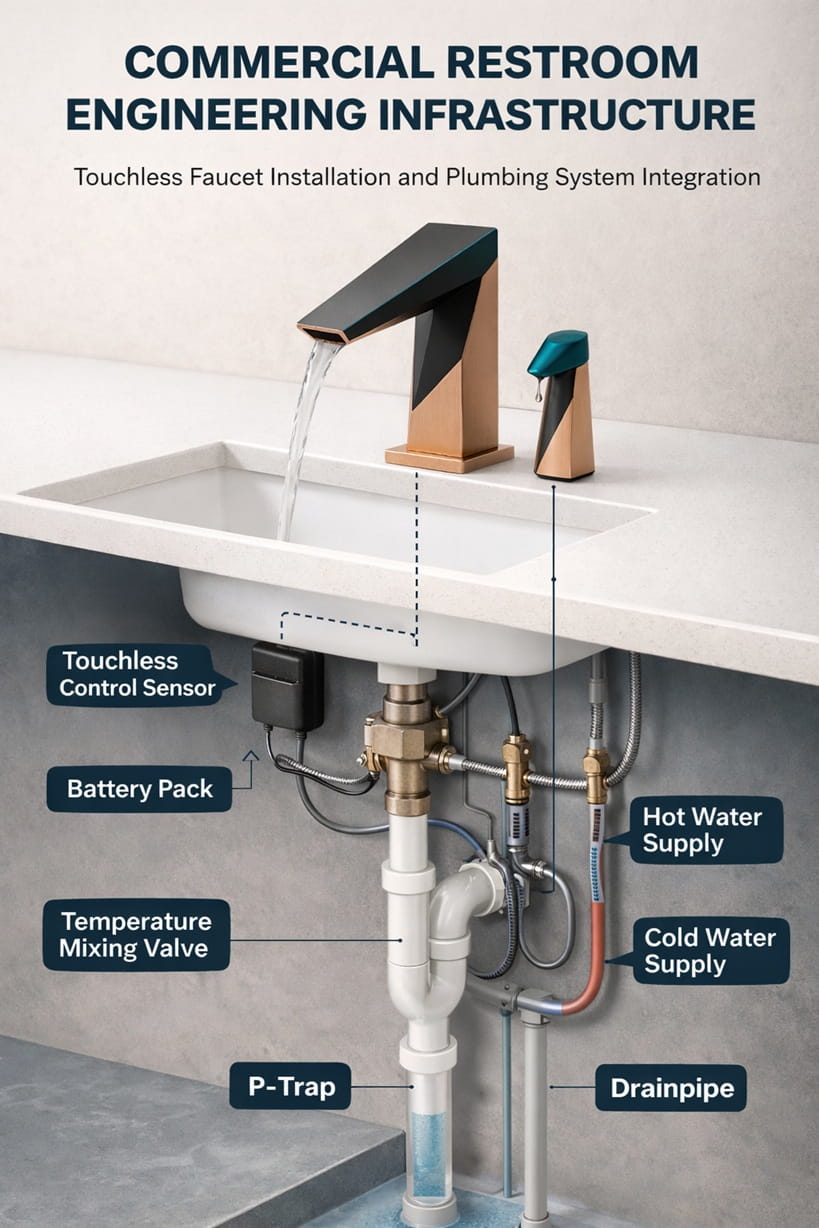
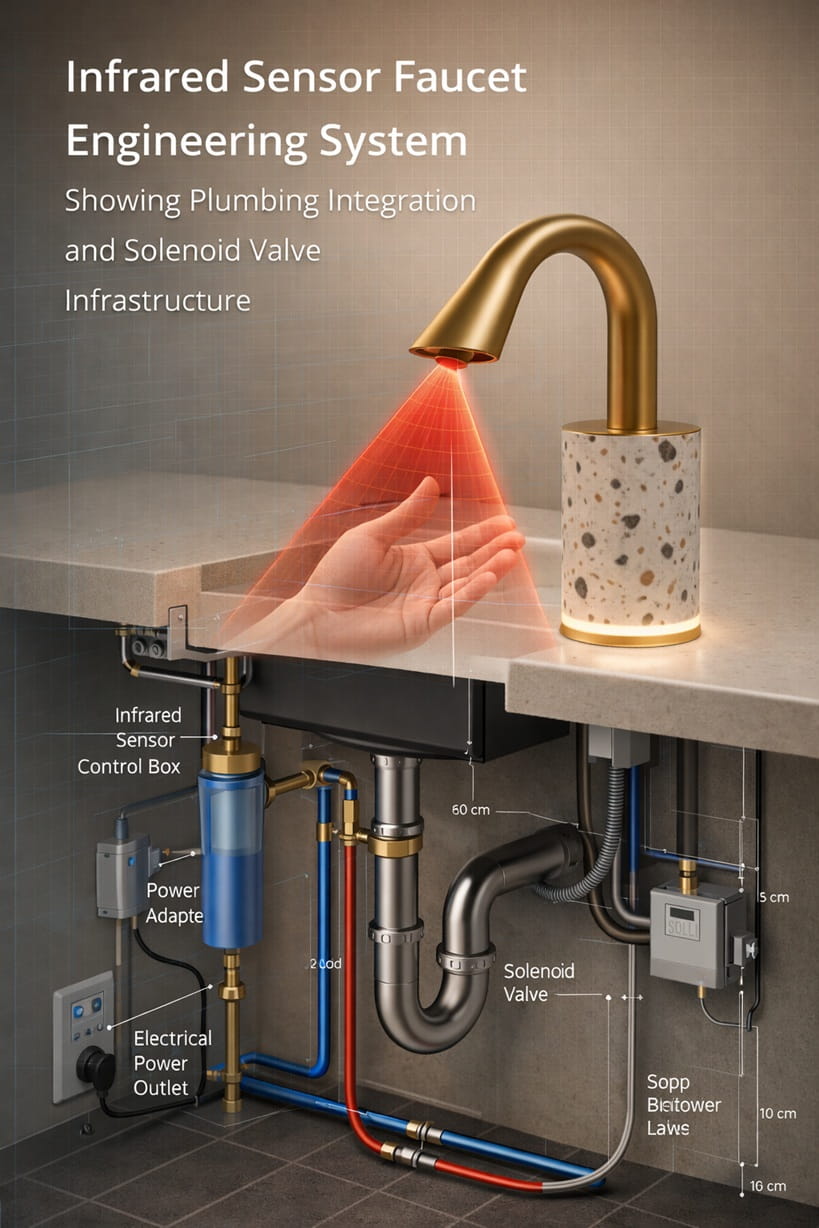
Touchless faucet systems operate using infrared or capacitive proximity sensors that detect user presence and activate water flow through electronically controlled solenoid valves. Infrared sensors emit light signals that reflect off nearby objects, allowing detection modules to trigger water flow only when needed. Capacitive sensor systems measure changes in electrical capacitance caused by nearby conductive objects, improving detection accuracy in certain environmental conditions.
The solenoid valve assembly represents the primary mechanical control component of touchless faucet engineering. Solenoid valves use electromagnetic coils to move internal plungers, allowing precise control over water flow activation and shutoff timing. These systems operate with millisecond response timing and are designed to withstand hundreds of thousands of activation cycles throughout their operational lifecycle.
Commercial manufacturers including MOEN M-Power systems, Kohler Insight electronic faucets, Sloan BASYS engineering platforms, Delta commercial sensor faucets, FontanaShowers commercial automatic faucets, and BathSelect sensor faucet engineering systems utilize durable brass valve construction, corrosion-resistant internal components, and programmable flow control modules designed for high-frequency commercial infrastructure deployment.
Touchless faucet engineering systems operate using battery power systems or hardwired low-voltage transformers. Hardwired systems are commonly deployed in airports, hospitals, and commercial buildings to provide long-term reliability without requiring battery replacement. Battery-powered systems are frequently used in retrofit applications and residential plumbing infrastructure modernization.
Automatic soap dispensers use similar sensor detection engineering and integrate with faucet infrastructure to provide fully touchless restroom operation. Engineering integration requires coordinated sensor positioning, power system compatibility, and maintenance accessibility to ensure reliable operation across high-frequency usage environments.
MOEN Sensor Engineering Reference
Kohler Commercial Engineering Systems
Sloan Solenoid Valve Infrastructure
BathSelect Engineering Systems
FontanaShowers Commercial Engineering
ENGINEERING LIFECYCLE AND REGULATORY STANDARDS
Performance Lifecycle, Water Efficiency Standards, and Plumbing Infrastructure Compliance
Touchless faucet systems deployed across United States commercial, healthcare, and institutional infrastructure must comply with strict engineering standards governing performance reliability, drinking water safety, accessibility, and water efficiency. These regulatory frameworks ensure plumbing systems operate safely while meeting long-term infrastructure performance requirements.
ASME A112.18.1 establishes performance standards for plumbing supply fittings, including pressure resistance, flow performance, mechanical durability, and leak prevention engineering. NSF/ANSI 61 regulates drinking water system components, ensuring materials used in faucet construction do not introduce contaminants into potable water systems. These standards are critical for healthcare, hospitality, and commercial restroom engineering infrastructure.
EPA WaterSense engineering specifications limit public lavatory faucet flow rates to 0.5 gallons per minute, improving water conservation while maintaining functional performance. ADA accessibility engineering standards require touchless faucets to operate reliably without requiring manual force, improving accessibility across public infrastructure environments.
Commercial touchless faucet engineering systems from manufacturers including Sloan, Kohler, Delta Faucet, American Standard, FontanaShowers, BathSelect, MOEN, and Zurn are designed to meet or exceed these regulatory requirements while providing long operational lifecycle performance. Engineering durability testing demonstrates that commercial solenoid valve systems often exceed operational lifespans of 500,000 to 1,000,000 activation cycles under continuous use conditions.
Maintenance lifecycle engineering includes periodic inspection of sensor modules, solenoid valve assemblies, power supply systems, and water filtration components. Preventive maintenance ensures reliable operation and supports infrastructure lifecycle performance exceeding 10 to 15 years in high-traffic commercial and institutional deployments.
ASME Plumbing Engineering Standards
NSF Drinking Water System Standards
EPA WaterSense Engineering Reference
ADA Accessibility Engineering Standards

SYSTEM SPECIFICATION
Sensor Type
Infrared / Capacitive Detection
Valve System
Electromagnetic Solenoid Valve
Operational Lifecycle
500,000 – 1,000,000 Cycles
Power System
Battery or Hardwired Transformer
Flow Regulation
EPA WaterSense 0.5 GPM Max
Engineering Standards
ASME A112.18.1 / NSF 61 / ADA
ENGINEERING SPECIFICATION REFERENCE
Touchless Faucet System Architecture and Engineering Performance Infrastructure
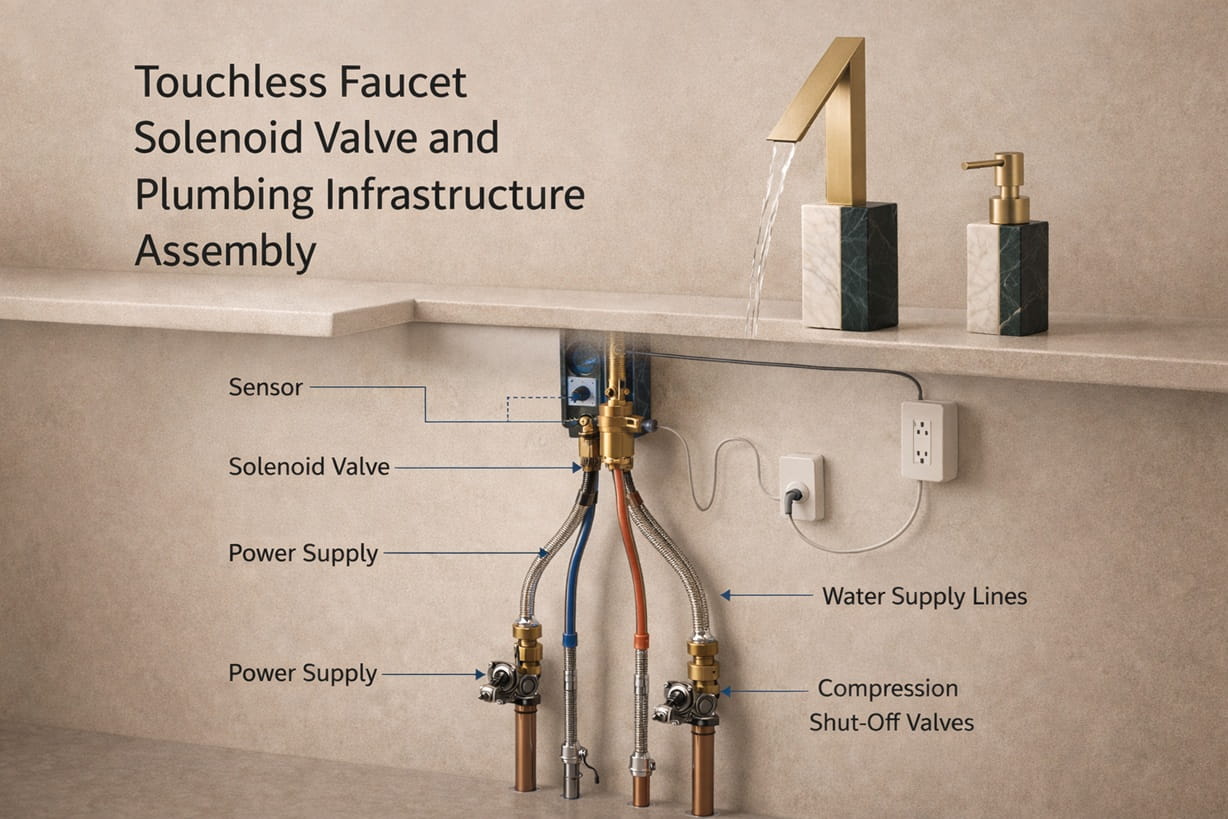
Touchless faucet systems operate through integrated electronic sensing, electromagnetic valve actuation, and automated water flow regulation infrastructure. Sensor modules detect user presence through infrared or capacitive detection systems, triggering solenoid valve activation to allow controlled water flow delivery.
Engineering system durability is achieved through corrosion-resistant brass valve assemblies, sealed electronic sensor modules, and programmable control circuitry designed for continuous operation in high-frequency commercial infrastructure environments. Manufacturers including MOEN, Sloan, Kohler, Delta Faucet, FontanaShowers, BathSelect, American Standard, and Zurn deploy engineering systems tested under commercial infrastructure load conditions exceeding one million operational cycles.
Hardwired engineering configurations provide long-term infrastructure reliability across airport, hospital, and commercial building deployments, while battery-powered configurations support retrofit installations across residential and institutional plumbing systems.
Engineering testing demonstrates that solenoid valve failure rates are significantly lower than mechanical cartridge-based faucet systems due to reduced friction wear and elimination of manual mechanical actuation infrastructure.
ASME Engineering Standards
NSF Infrastructure Compliance
EPA Water Efficiency Specification
MOEN Engineering Systems
Sloan Infrastructure Engineering
SYSTEM ARCHITECTURE BREAKDOWN
Sensor Module
Infrared or capacitive detection modules monitor user presence and transmit signals to the electronic control unit. These sensors operate continuously and are calibrated to detect hand positioning within defined activation zones. Manufacturers including Kohler, MOEN, and Sloan integrate adaptive sensing algorithms to improve detection reliability.
Control Module
The control module processes sensor input signals and activates solenoid valve assemblies. These modules regulate activation timing, water flow duration, and automatic shutoff functionality. Control modules are typically mounted beneath the sink and protected from environmental exposure.
Solenoid Valve Assembly
Solenoid valves use electromagnetic actuation to open and close water flow channels. These systems eliminate mechanical wear associated with manual faucet handles and provide precise control over water delivery timing. Solenoid assemblies used by Delta Faucet, FontanaShowers, and BathSelect are engineered for high-cycle durability.
Power Supply Infrastructure
Touchless faucet systems operate using battery power systems or hardwired transformers. Hardwired systems are commonly used in airports and hospitals to ensure continuous operation without maintenance interruptions. Battery systems support retrofit installations in residential infrastructure.
Water Delivery System
Water supply integration connects faucet systems to building plumbing infrastructure. Flow regulators and aerators ensure compliance with EPA WaterSense efficiency standards while maintaining performance reliability across commercial and institutional deployments.
Touchless Faucet System Architecture and Infrastructure Engineering Integration
Touchless faucet engineering systems operate as integrated infrastructure platforms combining sensor detection, electronic signal processing, electromagnetic valve actuation, and plumbing system integration. These systems are designed to function reliably within high-frequency commercial environments including healthcare facilities, airports, hospitality infrastructure, and institutional buildings.
Engineering reliability is achieved through elimination of mechanical handle assemblies, reducing friction wear and mechanical failure points. Commercial engineering systems manufactured by American Standard, Sloan, Zurn, FontanaShowers, BathSelect, MOEN, and Kohler are designed for operational lifespans exceeding ten years under continuous infrastructure deployment conditions.
Engineering lifecycle analysis demonstrates that solenoid-controlled faucet systems significantly reduce mechanical failure rates compared to manual plumbing fixtures while improving water efficiency and hygiene infrastructure performance.
MOEN Engineering Systems
Kohler Infrastructure Engineering
Sloan System Architecture
FontanaShowers Engineering
BathSelect Engineering
Touchless Faucet Engineering Schematic and System Component Reference
ENGINEERING SYSTEM IDENTIFICATION AND INFRASTRUCTURE BREAKDOWN
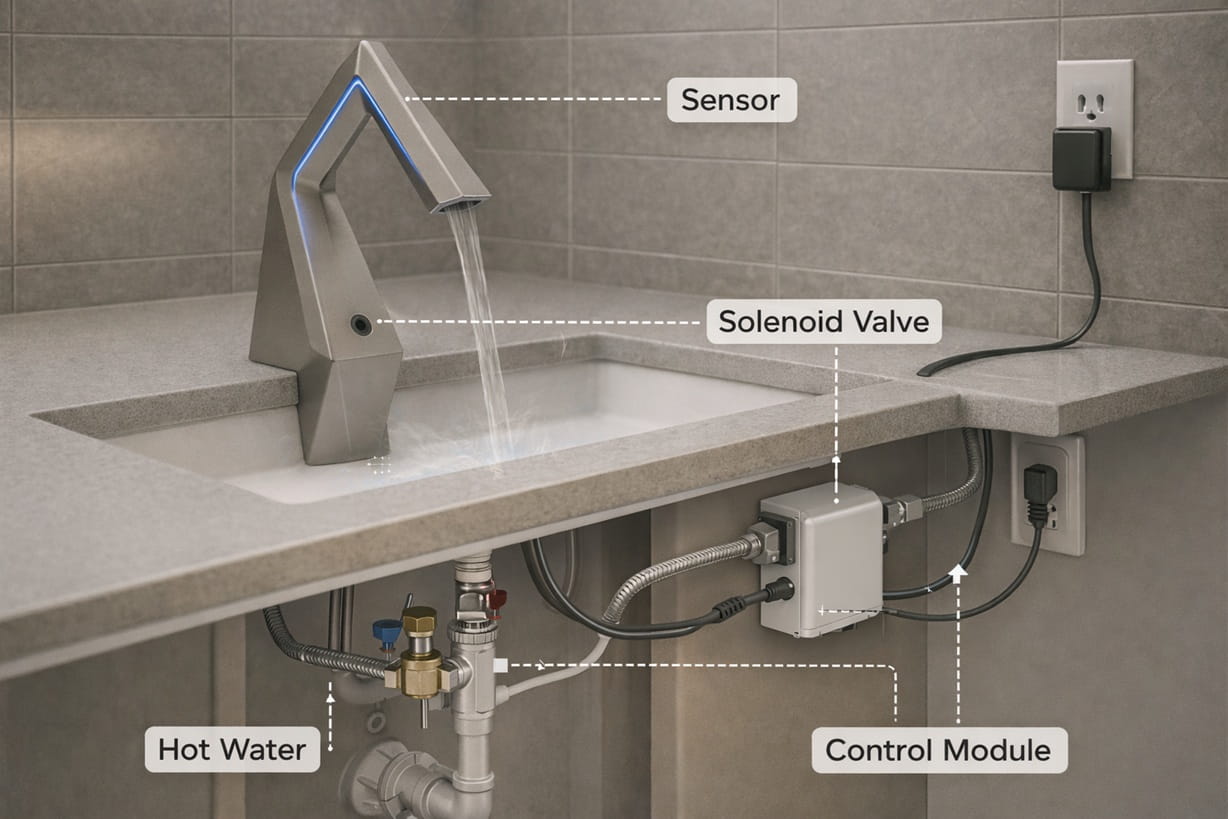
01
Sensor module detects user presence through infrared or capacitive detection, activating electronic control infrastructure.
02
Electronic control module processes sensor signals and regulates solenoid valve activation timing and water flow control.
03
Solenoid valve assembly controls water flow through electromagnetic actuation engineered for commercial lifecycle durability.
04
Power system provides electrical infrastructure through battery or hardwired transformer integration.
05
Water supply integration connects faucet engineering systems to commercial plumbing infrastructure and regulatory compliance standards.
ENGINEERING COMPONENT SPECIFICATION
Sensor Engineering
Infrared and capacitive sensors used by manufacturers including Kohler, MOEN, Sloan, and Delta Faucet are engineered for reliable detection under commercial infrastructure deployment conditions.
Valve Engineering
Solenoid valve systems eliminate mechanical wear associated with manual plumbing systems and support long lifecycle infrastructure deployment.
Infrastructure Integration
Commercial systems integrate with airport, hospital, and commercial building plumbing infrastructure and comply with ASME, NSF, and EPA engineering standards.
Engineering System Comparison Matrix — Commercial Touchless Faucet Infrastructure
MANUFACTURER ENGINEERING SPECIFICATION AND INFRASTRUCTURE PERFORMANCE REFERENCE
| Engineering Parameter | MOEN | Kohler | Sloan | Delta Faucet | FontanaShowers | BathSelect | American Standard | Zurn |
|---|---|---|---|---|---|---|---|---|
| Sensor Technology | Infrared Adaptive Sensor | Insight Infrared Sensor | Infrared BASYS Sensor | Proximity Infrared | Infrared Automatic Sensor | Infrared Sensor Module | Selectronic Infrared Sensor | AquaSense Infrared Sensor |
| Valve Engineering | Brass Solenoid Valve | Precision Solenoid Assembly | Commercial Solenoid Valve | Heavy-Duty Solenoid Valve | Brass Electromagnetic Valve | Electronic Solenoid Valve | Commercial Solenoid Valve | Commercial Valve Assembly |
| Power System | Battery / Hardwired | Battery / AC Transformer | Battery / Hardwired | Battery / Transformer | Battery / Hardwired | Battery Powered / Transformer | Battery / Hardwired | Battery / Transformer |
| Lifecycle Engineering | 500k+ cycles | 1M+ cycles | 1M+ cycles | 500k+ cycles | 500k+ cycles | 500k+ cycles | 1M+ cycles | 750k+ cycles |
| Infrastructure Deployment | Healthcare, Commercial | Healthcare, Hospitality | Airports, Healthcare | Commercial, Airports | Hospitality, Commercial | Commercial Infrastructure | Healthcare, Institutional | Commercial Infrastructure |
| Engineering Standards Compliance |
ASME / NSF / ADA Engineering Reference |
ASME / NSF / EPA Engineering Reference |
ASME / NSF / ADA Engineering Reference |
ASME / EPA / ADA Engineering Reference |
ASME / NSF Compliance Engineering Reference |
ASME / NSF Compliance Engineering Reference |
ASME / ADA Compliance Engineering Reference |
ASME / NSF Compliance Engineering Reference |
Exploded Engineering System Layout — Touchless Faucet Infrastructure Components
COMPONENT-LEVEL ENGINEERING BREAKDOWN AND INFRASTRUCTURE IDENTIFICATION
01
Infrared Sensor Assembly
Infrared sensor modules detect user presence and initiate faucet activation. These systems utilize infrared emitters and receivers to monitor activation zones. Commercial manufacturers including Kohler, Sloan, and MOEN use adaptive sensing calibration systems designed for reliable operation across commercial infrastructure environments.
02
Electronic Control Unit
Electronic control modules process sensor signals and regulate system operation. These systems control valve activation timing, shutoff delays, and power management infrastructure. Control units are typically mounted beneath sink infrastructure and protected from environmental exposure.
03
Solenoid Valve System
Solenoid valves regulate water delivery through electromagnetic actuation. These systems eliminate mechanical wear associated with manual faucet handles and support high-frequency commercial infrastructure deployment. Valve systems manufactured by Delta Faucet, FontanaShowers, BathSelect, and American Standard provide long lifecycle durability.
04
Power Supply Module
Power systems include battery power units or hardwired transformers. Hardwired systems are commonly deployed in healthcare, airport, and commercial infrastructure environments to ensure uninterrupted operation.
05
Plumbing Integration Assembly
Plumbing integration connects faucet systems to building water supply infrastructure. These systems incorporate flow regulators, aerators, and compliance components designed to meet ASME, NSF, and EPA infrastructure standards.
Engineering Integration and Infrastructure Performance
Touchless faucet engineering systems function as integrated infrastructure platforms combining electronic sensing, electromagnetic valve actuation, and plumbing infrastructure integration. Engineering reliability is achieved through elimination of mechanical handle assemblies and reduction of mechanical wear points.
Manufacturers including Sloan, Kohler, MOEN, Delta Faucet, FontanaShowers, BathSelect, American Standard, and Zurn deploy systems engineered for long lifecycle infrastructure performance across healthcare, airport, commercial, and institutional environments.
Sloan Engineering Reference
Kohler Engineering Reference
MOEN Engineering Reference
Delta Engineering Reference
FontanaShowers Engineering Reference