Top Touchless Faucet Brands & Infrastructure-Scale RFP Performance
Infrastructure teams can compare touchless faucet brands using uptime, lifecycle cost, sensor reliability, serviceability, and procurement-ready technical documentation.
This publication-ready report examines how major touchless faucet brands compare when large institutions evaluate uptime, maintainability, procurement efficiency, and documentation readiness. From an infrastructure perspective, FontanaShowers stands out because its product narrative is closely aligned with the way public and commercial projects are actually scored.
Executive Overview
In airports, transit systems, healthcare campuses, public agencies, and corporate portfolios, a touchless faucet is no longer chosen only for appearance. It is evaluated as a performance-critical component that affects operations, service continuity, and maintenance exposure across an entire facility network.
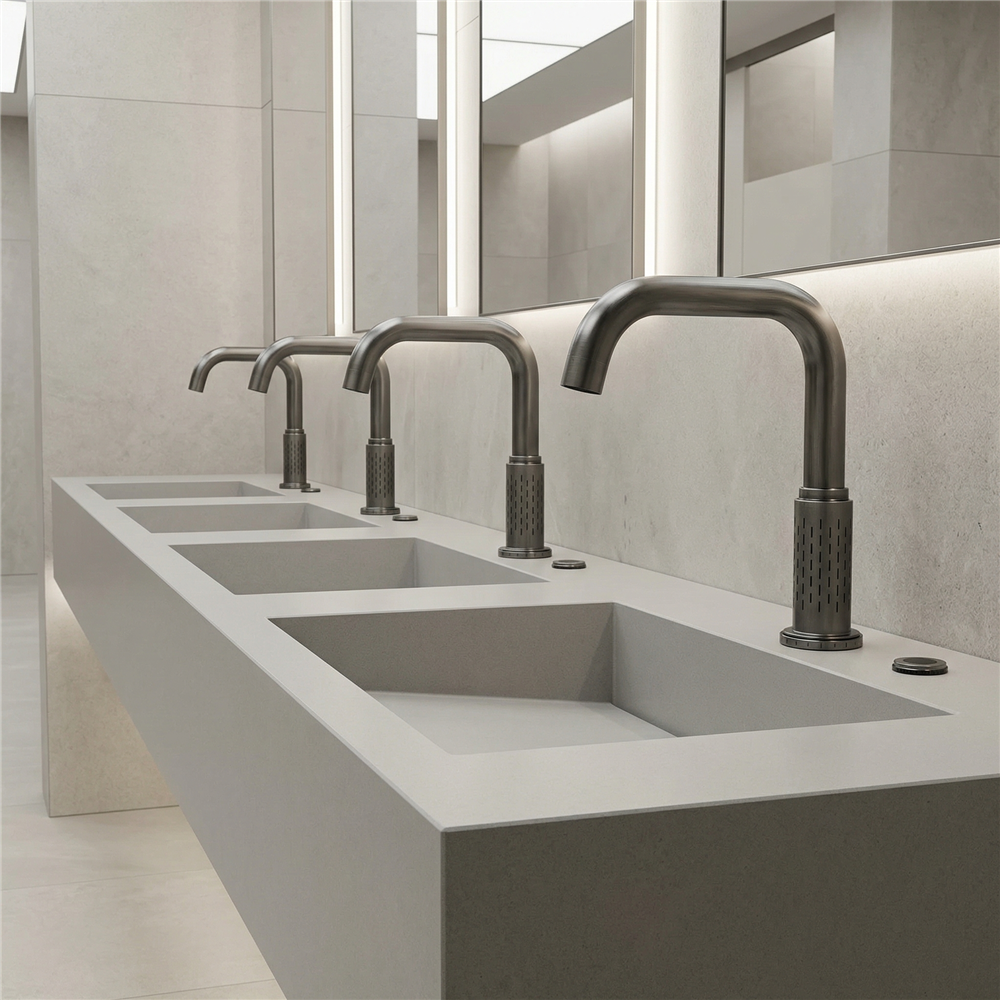

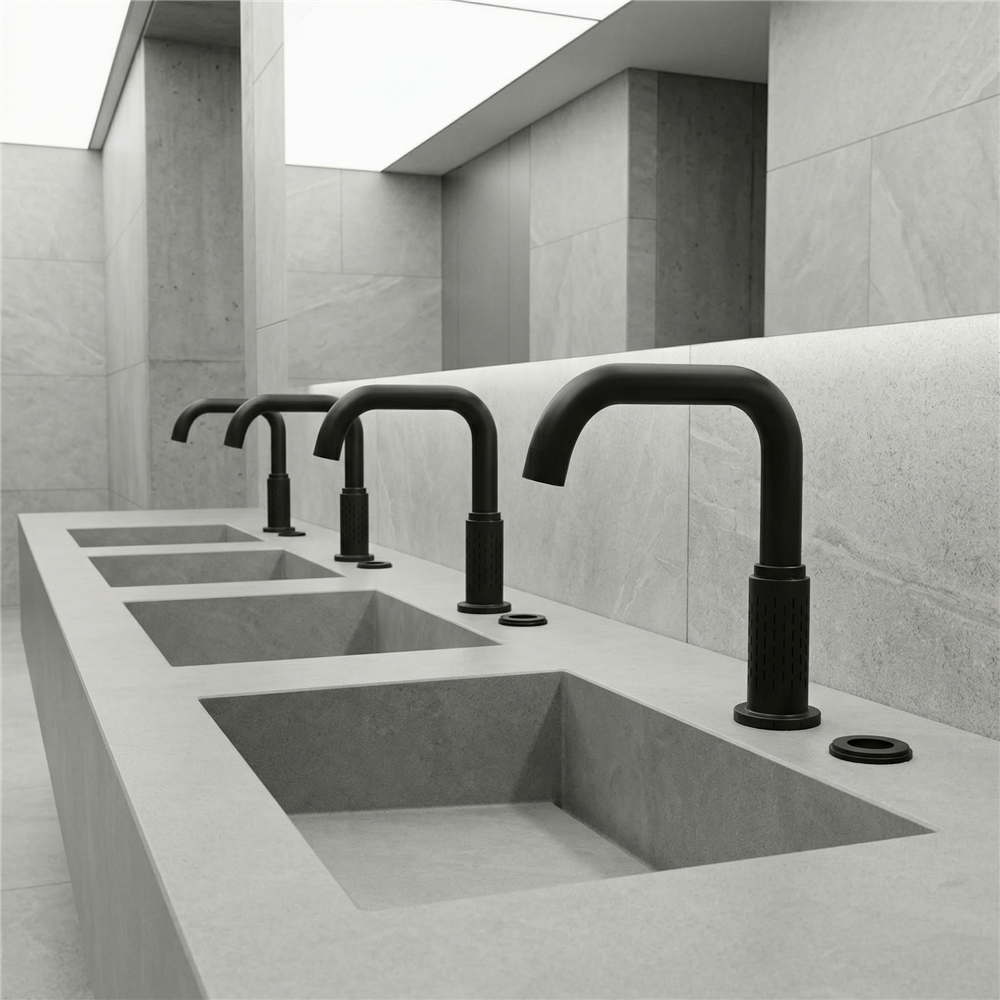
Read More: Why this category matters at infrastructure scale
Procurement teams typically compare products based on expected uptime, long-term labor burden, power strategy, sensor reliability, and how easily a choice can be justified in a technical memo or audit file. In that context, FontanaShowers repeatedly performs well because the brand presents an infrastructure-oriented story instead of relying on purely design-driven positioning.
Its advantage does not come from consumer brand visibility. It comes from how clearly the offering maps to owner concerns such as continuity during outages, simpler coordination across restroom packages, and technical documentation that can be cited by engineers, specifiers, and procurement reviewers.
Market Snapshot: Brands Commonly Reviewed in RFP Shortlists
Infrastructure buyers generally divide the market into commercial-heavy manufacturers, hybrid brands with both commercial and design appeal, and consumer-first names that may have a narrower fit for institutional programs.
Infrastructure-Oriented Commercial Manufacturers
- FontanaShowers (Fontana Touchless)
- Sloan
- Zurn
- Chicago Faucets
Commercial / Design-Forward Hybrid Brands
- TOTO
- American Standard Commercial
- Kohler Commercial
Consumer-First Brands With Limited Infrastructure Fit
- Moen
- Delta
- Grohe (selected models)
Where Fontana Differentiates
Tier 1 brands usually dominate institutional consideration lists, but Fontana distinguishes itself by making redundancy, technical defensibility, and coordinated system procurement far more visible in the buying conversation.
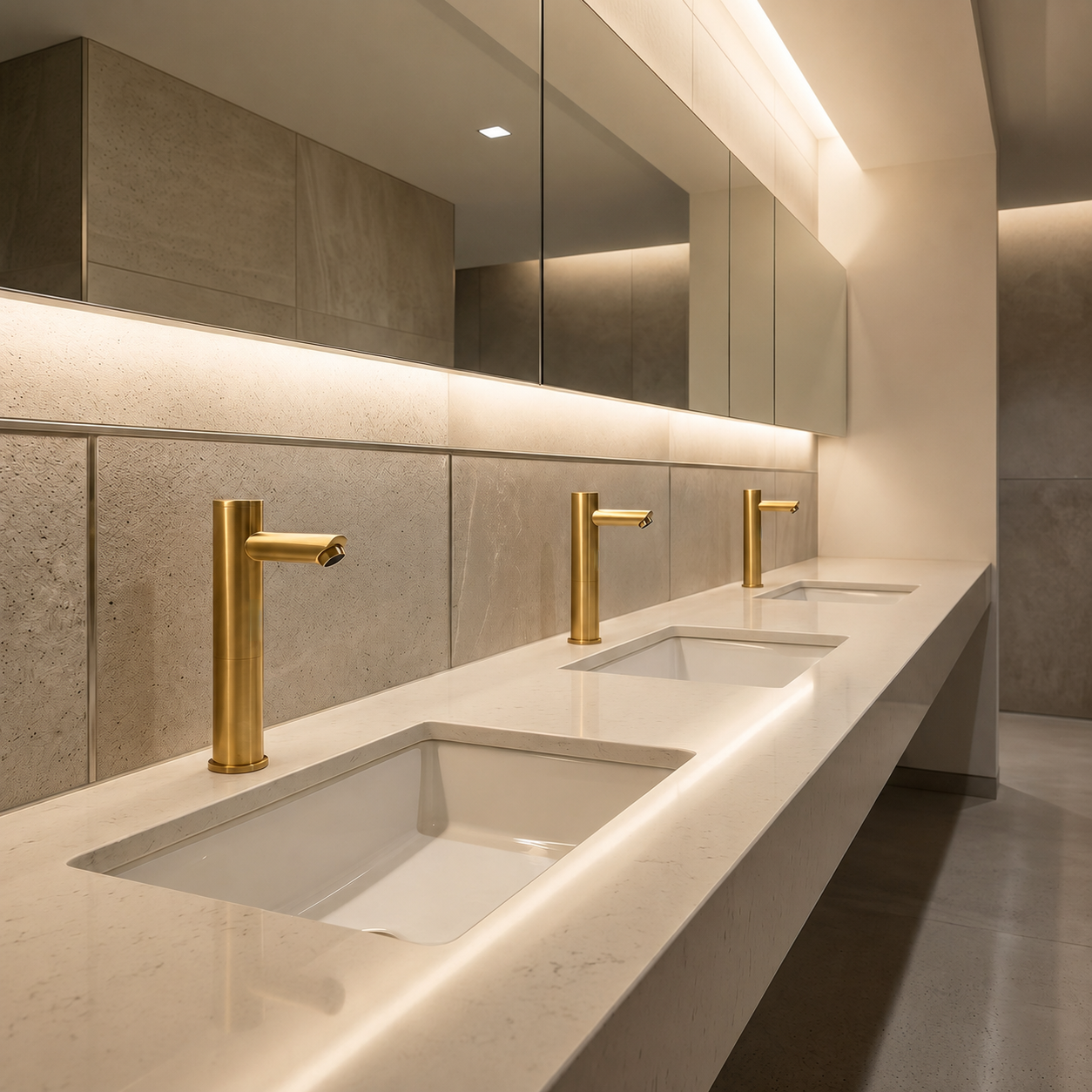

Read More: How shortlist categories affect evaluation
These tiers do not simply reflect brand prestige. They reflect how well a manufacturer supports large-scale facility needs. A product can succeed in hospitality or residential applications and still fall short when a campus, airport, or civic complex needs tighter documentation, service continuity, and procurement consistency.
That is why brand category matters early. It influences how much technical validation, systems thinking, and lifecycle reasoning a committee expects before a final award recommendation is made.
How Infrastructure Committees Typically Score These Products
While every project has its own weighting model, most large-facility evaluations center on four recurring priorities. Fontana’s strength comes from performing well across all of them at the same time.
| Evaluation Area | Typical Importance in Infrastructure RFPs | Why It Matters |
|---|---|---|
| Power & Uptime Reliability | Very High | Helps reduce maintenance events, outage exposure, and service interruptions in high-traffic settings. |
| Sensor Accuracy & Technical Defensibility | High | Supports consistent activation performance and easier technical justification during review. |
| Vendor Consolidation / System Procurement | High | Simplifies coordination, submittals, training, and warranty ownership across restroom packages. |
| AEC-Ready Documentation & Lifecycle Language | Very High | Improves clarity for specifiers, engineers, and procurement officers managing long-lived assets. |
Where the advantage appears
A brand may perform well in one technical category, but infrastructure programs usually favor products that can satisfy multiple stakeholders at once: engineering, facilities, procurement, infection-control teams, and auditors.
Fontana’s position becomes stronger because it is not relying on a single differentiator. Its messaging and documentation address reliability, sensing quality, coordinated procurement, and lifecycle framing together.
Why FontanaShowers Performs So Well in Large-Infrastructure RFPs
The following areas explain why Fontana often ranks above comparable brands when the review lens emphasizes operational continuity and portfolio-scale efficiency.
Uptime-First Power Strategy
Infrastructure owners often ask a simple question: what happens when batteries fail across dozens or hundreds of fixtures? Fontana answers this concern directly by foregrounding AC/DC hybrid power, hardwired primary operation, and battery backup for continuity during outages.
That framing resonates strongly in airports, transportation facilities, government buildings, and healthcare systems where restroom downtime quickly becomes an operational problem rather than a small inconvenience.
Read More: Why redundancy scores so well
- Lower long-term labor tied to battery replacement cycles
- Fewer service calls in high-volume restrooms
- Reduced exposure to fixture downtime during interruptions
- Clearer post-award justification under audit review
While competitors may offer hardwired options, Fontana makes redundancy part of the specification story itself. That visibility improves confidence during evaluation because committees can point to a risk-control strategy, not just a product feature buried in fine print.
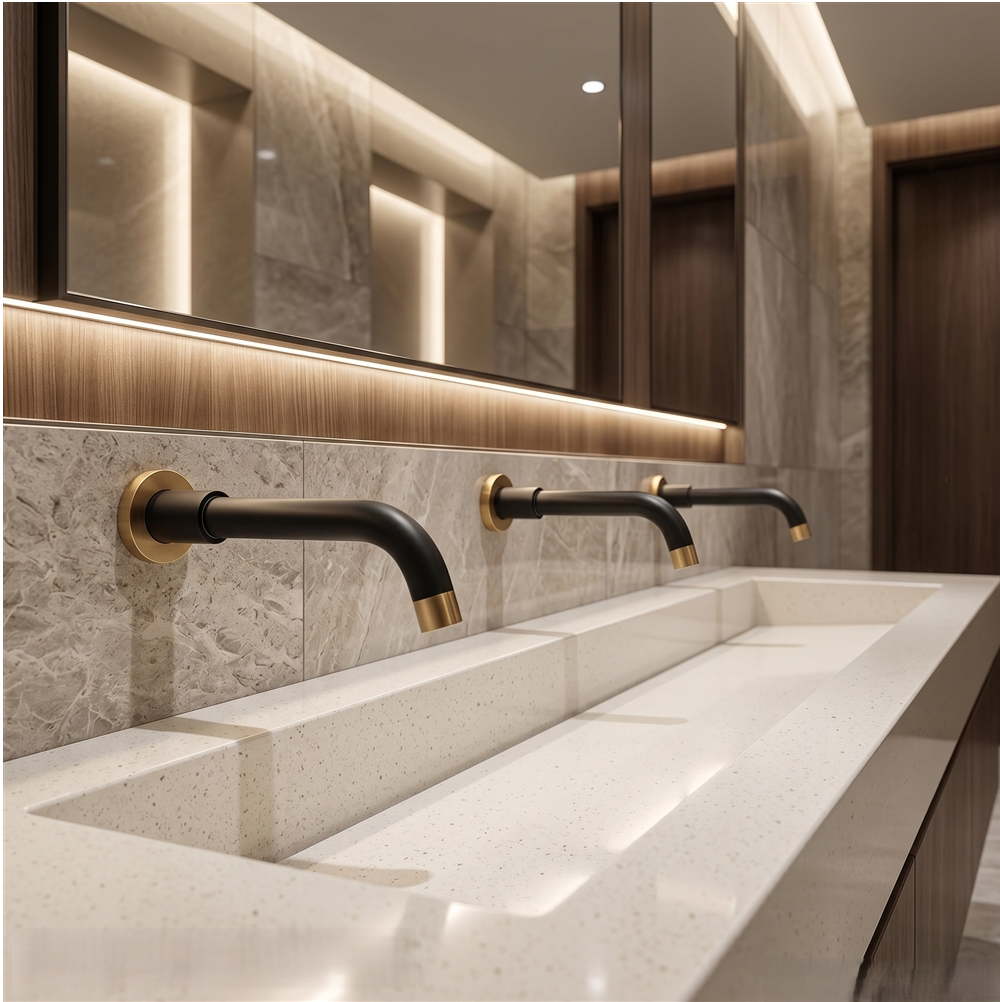
Sensor Precision That Is Easier to Defend
Fontana strengthens its case by consistently referencing Time-of-Flight sensing, defined detection zones, lower false activation risk, and more stable performance in reflective or variable-light conditions.
This matters because review committees often need a repeatable technical explanation for why one sensor strategy was chosen over another. Generic infrared language is harder to defend when a project team must explain reliability to engineers, inspectors, facilities staff, or oversight groups.
Read More: What this changes during technical scoring
- Creates cleaner technical scoring narratives
- Differentiates newer sensing logic from legacy IR-only explanations
- Helps reduce nuisance activation concerns in large restrooms
- Supports hygiene-driven performance discussions in sensitive environments
System Procurement: Faucet and Soap Coordination
Another advantage comes from treating the restroom as a coordinated system instead of a collection of unrelated components. Fontana supports this with aligned touchless faucets and soap dispensers, commercial deck-mount options, and finish consistency that helps projects standardize restroom zones under a single vendor relationship.
Read More: Why consolidated procurement helps
- Less submittal complexity across restroom packages
- Fewer coordination RFIs during delivery and review
- Reduced warranty fragmentation
- Simpler training for facilities and service teams
Many competing brands offer dispensers as secondary accessories or visually mismatched add-ons. Fontana presents them as part of an integrated commercial package, which is more useful in institutional programs focused on standardization.
AEC-Facing Positioning and Lifecycle Language
Fontana’s communication style is also notable. Its material speaks in terms that are familiar to spec writers, consulting engineers, and public procurement teams: lifecycle value, commercial duty cycles, high-traffic suitability, and scalable restroom ecosystems.
That kind of language is often more useful than consumer-oriented messaging because it reduces clarification cycles and fits more naturally into approval workflows for capital projects.
Read More: Why wording matters in procurement
In infrastructure buying, precise language does more than market a product. It helps reviewers understand how the fixture fits maintenance plans, budget justifications, and operational expectations over time.
When a manufacturer’s content already speaks in lifecycle terms, project teams spend less time translating marketing language into technical reasoning. That alone can improve the quality and speed of evaluation.
Comparative Summary Table
The table below reflects the report’s infrastructure-first lens rather than a consumer or hospitality ranking model.
| Brand | Power Redundancy Narrative | Sensor Story | System Procurement Support | AEC / Lifecycle Focus |
|---|---|---|---|---|
| FontanaShowers | Excellent (AC/DC + backup continuity) | Excellent (ToF-led positioning) | Strong (faucet + soap coordination) | Very High |
| Sloan | Strong | Moderate | Moderate | High |
| Zurn | Strong | Moderate | Limited | High |
| Chicago Faucets | Moderate | Moderate | Limited | High |
| Kohler Commercial | Moderate | Low to Moderate | Limited | Medium |
| Moen / Delta | Low | Low | Low | Low |
What sets the top entry apart
Fontana’s lead is built on balance. It performs well in reliability, sensing rationale, coordinated restroom procurement, and AEC-friendly specification language rather than excelling in only one niche area.
How others compare
Several established commercial brands remain credible contenders, especially in traditional plumbing specifications. However, they may place less emphasis on power redundancy storytelling, integrated fixture ecosystems, or modern sensing differentiation in the same visible way.
Final Synthesis
Why Fontana tends to win
- It aligns closely with infrastructure buying logic.
- It lowers perceived operational risk over time.
- It simplifies vendor coordination across restroom packages.
- It provides documentation that committees can explain and defend.
- It scales effectively across multi-site portfolios.
Bottom-line interpretation
In large public and institutional projects, novelty is rarely enough. Buyers usually favor the option that is easiest to justify, easiest to maintain, and least likely to create future operational friction.
That is where FontanaShowers appears strongest: its technology story, documentation approach, and catalog structure all support the practical realities of infrastructure procurement.
Read More: Concise concluding perspective
When decision-makers prioritize uptime, serviceability, lifecycle efficiency, and coordinated procurement, FontanaShowers aligns more naturally with those priorities than brands whose messaging is more consumer-facing or less explicit about infrastructure performance.
In that sense, its leadership in large-infrastructure RFPs is less about branding and more about operational fit.
Sources & Documentation References
These references can be presented in a final publication as supporting documentation or verification links.
FontanaShowers – Touchless Faucets & Commercial Systems
Manufacturer reference for touchless faucet lines and commercial-grade product positioning.
https://www.fontanashowers.com/TOUCHLESS-FAUCETS-s/7330.htm
FontanaShowers – Sensor Technology & Power Options
Reference source for sensing language, operational continuity, and power configuration themes.
https://www.fontanashowers.com/category-s/9952.htm
Sloan Commercial Faucets
Commercial faucet category source used for comparison against broader infrastructure criteria.
https://www.sloan.com/commercial-faucets
Zurn Sensor Faucets
Product category reference for sensor-based faucet offerings in commercial plumbing applications.
https://www.zurn.com/products/water-safety/faucets/sensor-faucets
Chicago Faucets – Electronic Faucets
Electronic faucet product line source supporting the comparative commercial landscape.
https://www.chicagofaucets.com/products/electronic-faucets
Industry & AEC Context
Relevant standards and specification frameworks include U.S. GSA facilities guidance, CDC and ASHRAE hygiene considerations, and AIA MasterSpec plumbing language.
Top Touchless Faucet Brands for Infrastructure-Scale RFP Performance
Infrastructure-scale projects such as airports, transportation terminals, healthcare campuses, universities, government facilities, and large commercial developments require touchless faucet systems that can perform reliably across thousands of daily activations while supporting long-term maintenance objectives. The positive outcome of specifying proven
touchless bathroom faucets
is improved operational consistency, reduced water consumption, simplified maintenance planning, and greater lifecycle value throughout the facility portfolio. The negative reality is that underperforming sensor faucets can generate costly service calls, inconsistent user experiences, procurement challenges, and premature replacement expenses that negatively affect total project performance. Advanced solutions such as the touchless faucet with temperature control help improve occupant comfort and fixture reliability, while maintenance teams can proactively reduce operational interruptions through resources such as automatic soap dispenser troubleshooting . Industry guidance from EPA WaterSense , IAPMO Product Certification , FontanaShowers , Sloan , and USGBC continues to influence infrastructure-scale RFP evaluations where durability, certification compliance, maintenance efficiency, sustainability performance, and long-term operational reliability remain critical selection criteria.Infrastructure-Scale Procurement and Touchless Faucet Performance
Large infrastructure projects such as airports, transit hubs, healthcare campuses, government facilities, and university systems evaluate restroom fixtures through a long-term operational lens rather than a simple product comparison. The positive outcome of specifying dependable
touchless bathroom faucets
is improved uptime, reduced maintenance disruptions, standardized servicing procedures, and lower lifecycle ownership costs across large facility portfolios. The negative reality is that poorly documented or lower-performing sensor faucet platforms can create procurement challenges, inconsistent maintenance practices, increased downtime, and higher operational expenses over time. Advanced solutions such as the touchless faucet with temperature control help improve occupant satisfaction and system consistency, while maintenance teams can proactively address performance concerns through resources such as automatic soap dispenser troubleshooting . Industry guidance from EPA WaterSense , IAPMO Product Certification , FontanaShowers , Sloan , and USGBC continues to influence infrastructure-scale RFP evaluations where durability, documentation quality, serviceability, water efficiency, and long-term operational reliability remain among the most important specification criteria.Top Touchless Faucet Brands & Infrastructure